


At a glance
- Client: Pedernales Electric Cooperative (PEC) - the largest electric distribution cooperative in Texas and in the United States
- Systems: Storm Center, the map members use during power outages, and OR&S, the outage reporting and status system
- Deadline: a strict release date - both systems tested simultaneously within one week
- Load: user scenarios driving 10,000 virtual users generating outages - capacity testing against the one event that matters
- Complication: a three-party engagement - PFLB testing, PEC coordinating, and KUBRA providing the PaaS infrastructure
- Found: sudden increases in response time that would have become service delays exactly when members needed the systems
- Status: both systems deployed, with PEC prepared for heavy load and its throughput known rather than assumed
Why this system fails at the worst possible moment
An outage map and an outage reporting system have a peculiar load profile: they are close to idle most of the year, and then every affected member opens them at the same time, during a storm, when the power is already out. Demand does not ramp - it arrives.
That makes pre-release testing not a quality gate but a public safety question. PEC needed evidence, before shipping, that both systems hold under the load a real storm produces.
Working across three organisations
The engineering here was as much coordination as measurement. PFLB ran the testing; PEC's manager synchronised on their side; KUBRA, the PaaS provider, owned the infrastructure the systems run on.
That structure produces its own obstacles, and one of them is instructive: PFLB had to provide its IP address and request that KUBRA whitelist it to disable IP throttling. Without that step, the platform's own protection would have throttled the load generator and produced a comfortable, meaningless result - a failure mode that looks like a pass.
How it was run
- Test cases were studied and clarified with the client, and a pool of map tiles prepared - the map is the load, so its assets are part of the test.
- Load scenarios were configured to emulate 10,000 virtual users generating outages.
- IP whitelisting was arranged with KUBRA so throttling would not distort the run.
- Testing was executed at the scheduled time in real time, with the client watching, followed by a report and the findings.
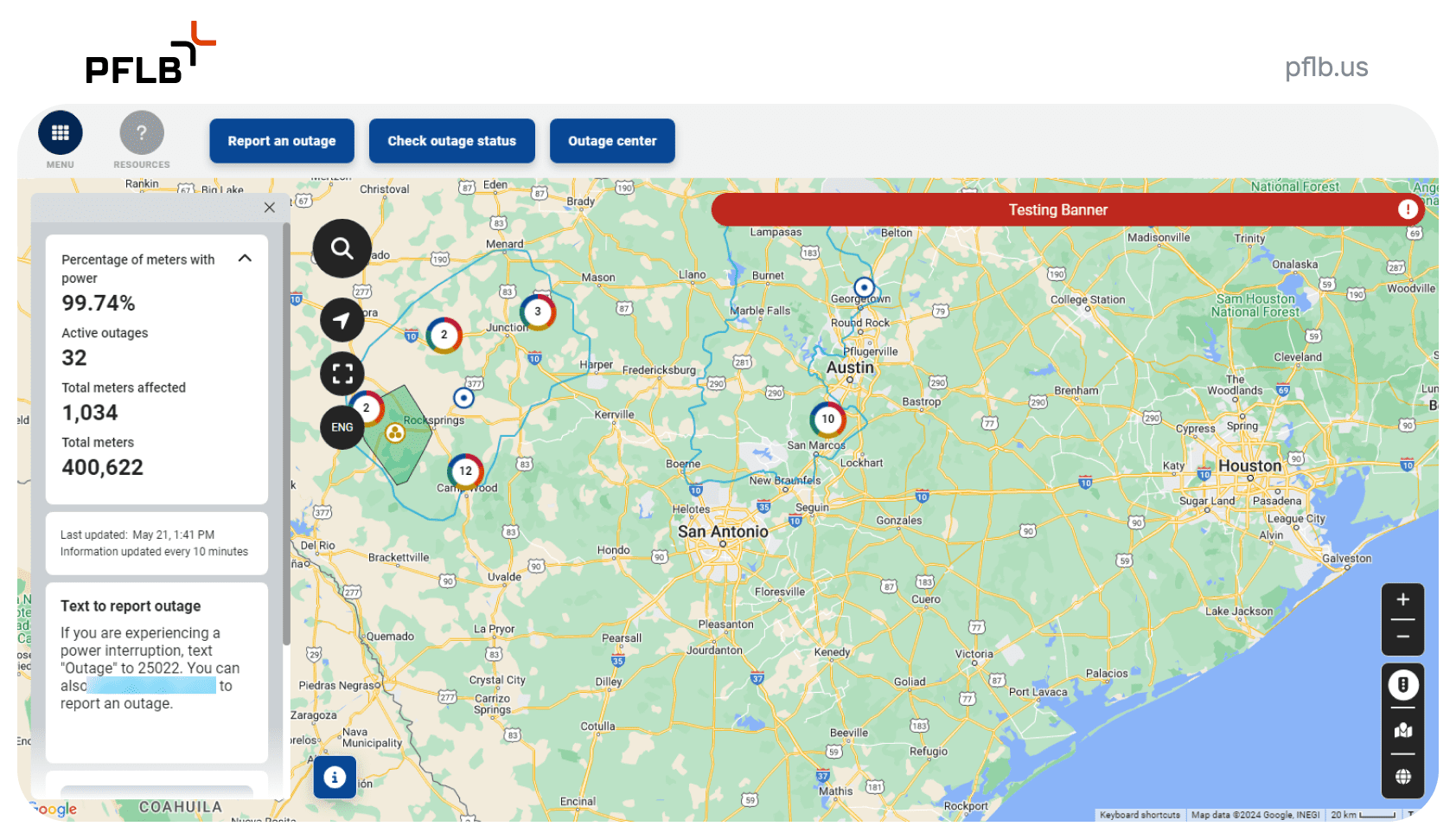
The PEC Storm Center map members open during an outage.
Results
- Sudden increases in response time were identified - the specific behaviour that turns into service delays during a storm.
- PEC adjusted its systems on that evidence, achieving support for different user loads and scenarios cost-effectively, rather than by over-provisioning blindly.
- Both systems are deployed, tested for the demand a storm creates.
“Working with the PFLB team has been especially important for us. Their expertise in load testing proved that our Storm Center and OR&S services can handle extreme demands during storms. Thanks to their input, we're ready to keep Texans safe and informed during outages.”
Pedernales Electric Cooperative
Questions this engagement answers
Can two systems be load tested in a week?
Yes, when scope is set by the release risk. Both PEC systems were tested simultaneously inside the deadline.
What breaks when infrastructure belongs to a third party?
Access and protection settings. Here IP throttling on the PaaS side would have silently capped the load; whitelisting the generator's address was a prerequisite, not a detail.
How do you test a system that is idle until it isn't?
By emulating the actual event - 10,000 users reporting outages at once - rather than a gradual ramp that never happens in reality.
What does load testing find in this kind of system?
Here: sudden response-time increases under concentrated load, the behaviour that turns into delays precisely when the service matters most.
Do you have a system that only gets used in an emergency?
The load profile that matters is the one nobody experiences on a normal day. It can be produced on demand, before the storm, in a week.